Firefox4 & the future of the Web
Firefox4 was released last month. It has been downloaded more than 57 million times worldwide since its release. The release has been successful so far, but it no longer seems as easy to compete with other browsers as it once was. In this post, I am going to talk about the new features of Firefox4, the reason why using Firefox is important, and the challenge of remaining competitive as a community-supported browser.
New features of Firefox4
First, let's take a look at the new features of Firefox4 [1].
App Tabs & Panorama
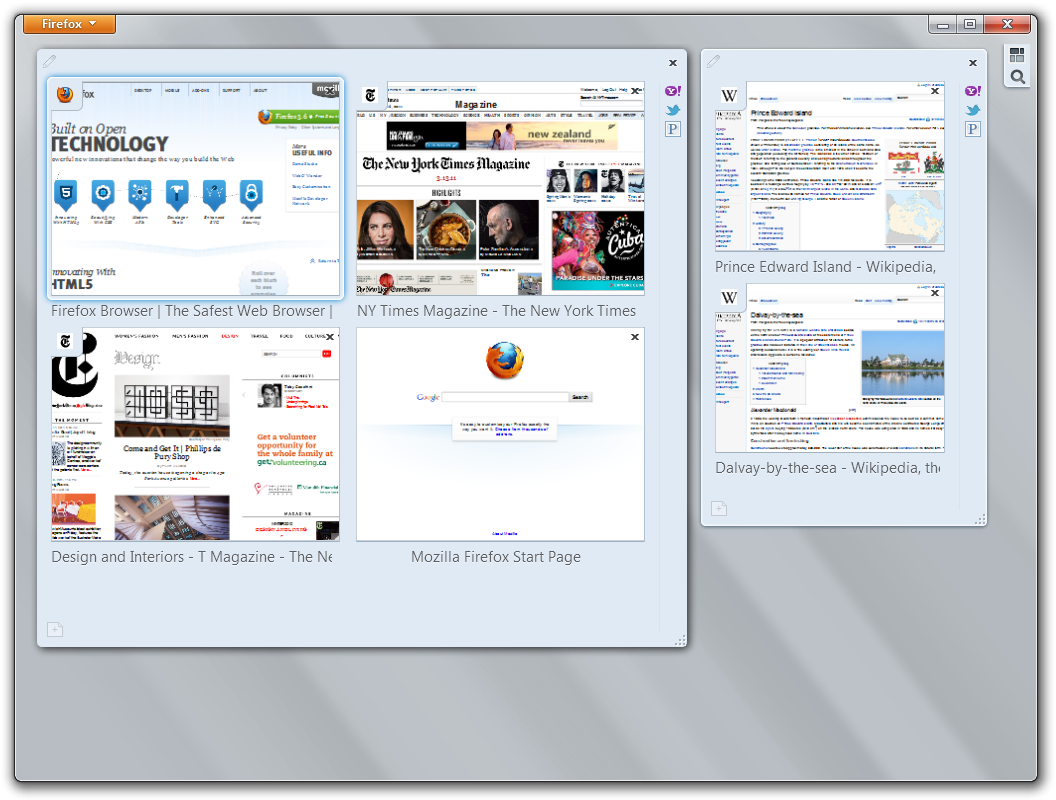
How many tabs do you open when using Firefox? In my case, I open more than 10 tabs, so it is very difficult to find the page I want. App Tabs and Panorama help you organize so many tabs. App Tabs are a kind of tab located on the left side of the tab area; they display only an icon, without a title, so you can fit more tabs in the tab area. Unlike normal tabs, App Tabs remain after the browser restarts. If you open Facebook, Twitter, and Gmail as App Tabs, you don't need to open those pages again. With Panorama, related tabs can be grouped together, as you can see in the figure above. This helps you find a tab more easily. In addition, you can move tabs between groups by drag and drop.
WebGL

WebGL brings 3D graphics to Firefox, allowing developers to create 3D games and 3D UIs for the Web. This link showcases several WebGL demos running on Firefox4, so you can imagine how the Web will change in the future.
In addition, Firefox4 introduces a lot of new technologies for Web developers:
- JägerMonkey JavaScript engine: a new JavaScript engine that replaced TraceMonkey, allowing JavaScript to run faster.
- WebM support: WebM is an open source, royalty-free video codec released by Google. It lets people author and distribute their own video without paying any royalties.
- HTML5 parser: this allows the browser to parse HTML content consistently, even when the content has errors.
- IndexedDB: the Web standard for databases.
- More File APIs: these make it easier to upload files.
- Audio API: this allows audio streams to be processed for mixing and equalizing.
- Multi-touch: multi-touch is supported on Windows 7.
- Web Console: this allows developers to check the content loading status from a console window.
For detailed information on the new features, take a look at the following page: http://www.mozilla.com/en-US/firefox/features/
Why Firefox?
Do you remember the dark age of the Web? After the browser war [2] between Internet Explorer and Netscape ended in the 1990s, Internet Explorer came to hold more than 95% of the market share by 2002. As a result, nobody cared about innovation in web browsers; until 2006 there was only one new version of Internet Explorer since version 6.0 was released in 2001. IT experts call this period the dark age of the Web, because there was no alternative to Internet Explorer. As a result, many websites became dependent on Microsoft's proprietary technology, like ActiveX controls. Firefox was created to give the Web back to people by ending the dark age, like Luke Skywalker in Star Wars.
Now, nobody dominates the Web, because Mozilla has done well to develop it using open technology and in a standard way through HTML5, CSS3, SVG, free codecs, and so on. This means there should be no barriers to viewing Web content from any browser on any platform. However, there are still threats from big companies. They could control the Web in their own way if they surpassed the other browsers. The ActiveX control issue in Korea is a well-known example. Therefore, we have to stay interested in spreading Firefox and keeping the Open Web. [3]
Future of Firefox
Open competition makes the Web innovate faster than before. Firefox has a unique position in the browser market: it is an open source project that has led the way in Web innovation. However, Google Chrome has also strongly driven Web innovation, supporting a multi-process model and Web-technology-based add-ons. Chrome is also an open source project with an open development process, like Firefox, so anyone can get involved in its development. In the mobile market, the situation is worse. Apple does not allow users to run Firefox on iOS, because Firefox could be an application platform in its own right. Another problem is that Firefox for Android is not popular yet.
So how does Mozilla overcome this situation? Mozilla is trying to move its development focus from platform to product. In addition, it is preparing the Mozilla2 project, a future platform for Firefox that lets each web page and add-on run in a separate process. In my opinion, Mozilla should release Firefox for the iPhone based on WebKit, because offering the same experience is more important than being tied to the Mozilla platform.
Firefox is not just a web browser; it provides a way to see the world and meet people. If we access the Web through decentralized tools like Firefox, nobody can control the Web, and everyone can use it equally without any restrictions.