My favorite hiking course in Seoul
Have you heard about Jeju Olle-gil (제주 올레길)[1] or Jirisan Dulle-gil (지리산 둘레길)? They are famous trails in Korea where you can hike through rural areas and enjoy nature. In particular, due to the success of Jeju Olle-gil, each provincial government is introducing new hiking courses to attract tourists. Actually, anyone can make their own hiking course, but many people don't realize that. In my case, I have one in Seoul, so I would like to introduce it in this blog.
It has been 7 or 8 years since I started hiking this route. I have hiked it with some of my friends, and most of them have been satisfied with my course, because it offers a good view of Gyeongbok-gung (Palace) and historical sites. There are also good cafes, restaurants, museums, and parks along the way, including two mountains.
This course starts from Sajik Park, near Gyeongbok-gung Station on Seoul Subway Line 3. The overall course is as follows:
Sajik Park (사직공원) => Inwang-san (인왕산) => Bukak-san (북악산) => Samcheong-dong gil (삼청동길) => Insa-dong (인사동)
This is just my own personal course, so you can make your own depending on your preferences or the time you have. Now, let's take a look at each point.
The starting point is Sajik Park. It is not a famous place now, but it was an important area in the Joseon dynasty. The purpose of Sajik Park was to hold a memorial ceremony for the gods of the land and the five grains (rice, millet, beans, wheat, and barnyard millet), which were the basis for stabilizing the dynasty. However, the Japanese Empire tore down the annexes and turned this area into the park that it is today.
The next point is Inwang-san. It doesn't seem high, but it is covered with rocks, so you need to wear hiking boots. When you reach the Inwang-san peak, you can see a complete view of Seoul, including Seoul Tower and every mountain surrounding Seoul, and even Incheon Airport if the weather is very clear. There is also a sad historic episode about an empress of the Joseon dynasty connected with Inwang-san. Her name was Empress Inhyeon (인현왕후)[2], a wife of Sukjong (the 19th king of the Joseon dynasty). She lost her position as empress due to court strife. After that, she went to the peak of Inwang-san wearing white clothes and made a deep bow toward the king every morning for three(?) years. Fortunately, she became empress again, but she died soon after without having had any children.
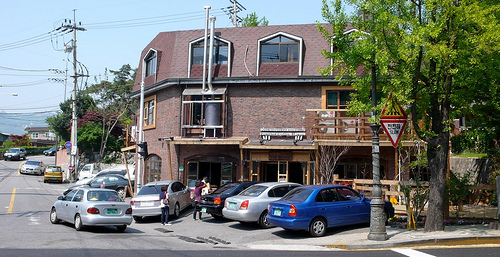
Before moving on to the next point, you can take a break at the cafe between Inwang-san and the entrance to Bukak-san, near Changeui-mun (창의문). This cafe offers various types of coffee made from beans grown in famous coffee-producing regions[5]. It is a great place to take a break and talk with your friends.
If you want to go to the top of Bukak-san[3], you should bring your resident registration card, driver's license, or passport (if you are a foreigner) due to the security of the Blue House. In fact, Bukak-san was off-limits for a long time after guerrillas from North Korea attempted to raid the Blue House and assassinate President Park Jeong-hee in 1969. As a result, the road up the mountain was closed for about 38 years. For this reason, development of this area was limited for a long time. So you may doubt whether you are still in Seoul during your hike up to the top of Bukak-san, because all you can see is green mountains and many detached houses.
Actually, Seoul was not always such a big city; it used to be a fortress capital during the Joseon dynasty. You can still find several gates in the Jong-ro district. Unfortunately, many parts of the city wall and some gates were destroyed during the Japanese occupation and the Korean War. Some parts of the city wall remain on Inwang-san and Bukak-san. In addition, you can find a secret gate near the top of Bukak-san. It is called "Sukjeong-mun (숙정문)".
There are two routes from Sukjeong-mun. One leads to Seongbuk-dong gil, and the other to Samcheong-dong gil. Here, I'd like to introduce the Samcheong-dong gil course, because it is close to Insa-dong gil. However, if you take the Samcheong-dong gil direction, it takes more time to hike down the mountain, so you can enjoy hiking longer in the forest of Bukak-san.
Samcheong-dong gil is one of the most beautiful streets in Seoul. There are many art shops, art galleries, cafes, museums, and restaurants. This area is a bit expensive, but the atmosphere and the quality of the food are quite good, so it would be a good choice for a nice meal with your closest friends. Before introducing some of them, I wonder whether you have heard the Korean proverb "금강산도 식후경". It means that eating comes first in any situation, so it would be good to stop by a restaurant first.
Most of the restaurants here are a bit expensive and meant for special occasions, but Samcheong-dong Sujebi[6] is cheap and simple. According to Wikipedia, "Sujebi is a Korean traditional soup consisting of dough flakes roughly torn by hand, with various vegetables." It also says that Koreans began eating Sujebi in the early Goryeo period, but my grandmother told me that Sujebi became common during the Korean War due to the significant rice shortage. At that time, the U.S. army gave wheat flour to Korean people as a form of food assistance. Many Koreans reluctantly had to eat flour-based foods, including Sujebi (because rice is the staple food of the Korean people). For this reason, it is very hard to find Sujebi restaurants these days. Anyway, this restaurant seems to be as old as Sujebi itself. Nevertheless, some bloggers complain that the taste is not as good as it once was, but it is still one of the Korean dishes you must taste.
After the meal, looking around the shops in Samcheong-dong is also good, especially for women. If you have enough time, I recommend visiting the Owl Museum[7] and the Tibet Museum[8]. These museums are very unique because they are run by private owners, so you can feel a different atmosphere compared to public museums.
The Owl Museum specializes only in owls, so you can find paintings, craftworks, and toys about owls. In the case of the Tibet Museum, there are various items related to Buddhist art, folk crafts, clothes, photos, and so on about Tibet. Although Tibet has been occupied by China since 1950, we can still see its unique culture. Before visiting these museums, you need to check their locations, because both are located on side streets. You also have to make sure that the museums are open when you want to go.
The last point on my course is Insa-dong gil. Insa-dong gil is too famous to introduce here, so I would only like to mention a traditional Korean teahouse in Insa-dong. As you know, Insa-dong gil is famous for its traditional teahouses. Unfortunately, traditional alcohol pubs are increasing these days, so finding real traditional teahouses is getting harder in Insa-dong.
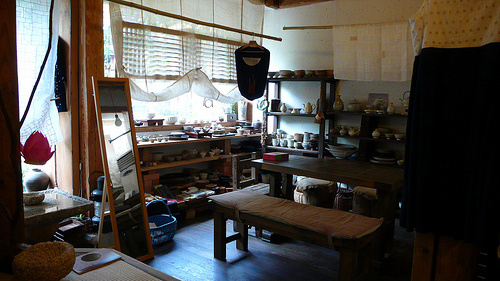
The picture above shows the interior of a teahouse I found by chance. I was actually trying to find Kyungin Art Gallery, because the gallery also offers Korean tea. Instead, I found a neat teahouse because I took the wrong side street. The teahouse is a real Hanok (Korean traditional house) and provides all kinds of equipment, such as pottery and trays. In addition, the hostess is very kind, so you feel like a guest in this house rather than a customer.
In conclusion, making your own hiking course is not difficult. Just try to remember which streets, cafes, and restaurants you have liked, and link all the points with some stories, such as historical episodes or your own memories. And if you share the course with your friends, your course will become rich with even more stories and attractions.
References
- [1] Welcome to Jeju Olle website, http://www.jejuolle.org:8080/eng/
- [2] Empress Inhyeon (인현왕후), http://bit.ly/9FsgLk
- [3] Welcome to Bukaksan, http://www.bukak.or.kr/
- [4] Seoul's best walking trails, http://www.koreaherald.com/lifestyle/Detail.jsp?newsMLId=20100624000575
- [5] Club Espresso, http://place.daum.net/place/Top.do?confirmid=9544927
- [6] Sujebi, http://en.wikipedia.org/wiki/Sujebi
- [7] The Owl Museum, http://www.owlmuseum.co.kr/
- [8] The Tibet Museum, http://en.wikipedia.org/wiki/Tibet_Museum_(South_Korea)